
Written by Roger Waters for Pink Floyd’s 1979 album The Wall, “Another Brick In The Wall” is a three-part rock song that critiques institutional conformity and charts the progressive emotional isolation of its protagonist, Pink. While best known for the chart-topping Part 2 single protesting rigid schooling, the song actually spans three distinct movements across the double album.
This breakdown examines how each part functions within the narrative arc, from childhood grief and institutional abuse to a total psychological shutdown. It also details Roger Waters’ personal inspirations, the recording of Part 2’s disco beat and children’s choir, and the song’s global impact as a protest anthem.
Another Brick In The Wall: Meaning, Three Parts, and History
“Another Brick In The Wall” is a three-part rock song written by Roger Waters for Pink Floyd’s 1979 concept album The Wall, best known for its chart-topping Part 2 single protesting rigid schooling and thought control. Anchored by a disco-influenced drum beat, a children’s choir, and David Gilmour’s iconic guitar solo, the song critiques institutional conformity and emotional isolation.
While most radio listeners instantly recognize the soaring guitar solo and schoolyard chant of Part 2, “Another Brick In The Wall” actually spans three distinct movements across the double album. Each part marks a progressive stage in the mental retreat of the album’s central protagonist, Pink, as he builds a metaphorical barrier between himself and a traumatizing world.
What are the three parts of “Another Brick In The Wall”?
Understanding “Another Brick In The Wall” requires examining how its three installments function within the narrative arc of The Wall. Rather than being three separate songs, they share a common musical theme in D minor while serving vastly different emotional roles.
- Part 1 (Reminiscing): Positioned early on side one of the album, Part 1 is quiet, eerie, and sparse. Built around a slow, pulse-like bassline and David Gilmour’s delay-drenched guitar rhythm, it captures Pink as a child processing the death of his father in World War II. The absence of a father becomes the foundation stone of his psychological barrier—the initial brick in his wall.
- Part 2 (Schooling): The famous single combines bitter critique with an infectious 100 BPM dance beat. Here, the adult Pink looks back at the post-war British school system, where teachers used sarcasm, ridicule, and corporal punishment to break children’s spirits. The track features a two-verse structure, with the second verse delivered entirely by a chorus of school children, followed by Gilmour’s signature guitar solo.
- Part 3 (Drugs and Breakdown): Placed near the end of side three, Part 3 is short, loud, and aggressive. Following a sequence of personal betrayals and emotional collapse, Pink violently rejects drugs, relationships, and human sympathy. Driven by heavily distorted guitars, frantic drumming, and sound effects of crashing glass, Pink declares his wall complete, concluding that everyone in his life was merely a brick.
| Feature | Part 1 | Part 2 | Part 3 |
|---|---|---|---|
| Narrative focus | Childhood grief over father’s wartime death | Institutional abuse and forced conformity | Total emotional shutdown and isolation |
| Tempo and musical style | Slow, atmospheric, quiet pulse | 100 BPM dance-disco rock beat | Fast, heavy, aggressive hard rock |
| Key instrumentation | Echoed guitar, simple bass, quiet vocals | Children’s choir, disco drums, Stratocaster solo | Distorted guitars, shouting vocals, breaking glass |
| Core thematic line | “Daddy, what did you leave behind for me?” | “We don’t need no thought control” | “I don’t need no arms around me” |
What inspired Roger Waters to write the song?
The origins of “Another Brick In The Wall” lie in the personal history of bassist and principal songwriter Roger Waters. Raised in post-war Britain, Waters attended the Cambridgeshire High School for Boys, where he experienced an educational culture that relied heavily on corporal punishment, public shame, and rigid authority. Teachers frequently mocked students who demonstrated artistic sensitivity or challenged institutional rules.
Waters lost his father, Eric Fletcher Waters, at the Battle of Anzio in 1944 when Roger was only five months old. Growing up without a father in a strict, regimented environment deeply shaped his worldview. Waters recalled how teachers seemed interested only in molding children into compliant, predictable units rather than encouraging independent thought.

The phrase “another brick in the wall” grew out of this feeling of dehumanization. Every abusive remark, arbitrary rule, or personal loss was experienced as a heavy brick added to a self-protective barrier. According to details archived on the official Pink Floyd website, the band sought to capture the defiant energy of a school playground chant, which eventually led to the signature children’s choir element in Part 2.
How was “Another Brick In The Wall (Part 2)” created?
Although Part 2 became Pink Floyd’s biggest hit single, its final structure was largely shaped during production rather than in early rehearsals.
The disco beat decision
In its original demo form, Part 2 consisted of a single verse and chorus played over a acoustic guitar and bass line lasting under two minutes. Co-producer Bob Ezrin recognized the hit potential of the melody but felt the rhythm lacked driving energy. Having spent time in New York dance clubs where disco was dominating radio play, Ezrin suggested adapting a steady four-on-the-floor beat at 100 beats per minute, similar to records by Chic.
The band was initially hesitant to incorporate dance rhythms into a progressive rock track. However, drummer Nick Mason and Roger Waters recorded the steady pulse, while David Gilmour added rhythm guitar chords played with a tight, muted funk technique. Ezrin also realized the song was too short for a commercial release and insisted on duplicating the backing track to accommodate a second verse and an extended guitar solo.
The Islington Green School choir
To fill the second verse with an authentic children’s voice, sound engineer Nick Griffiths visited Islington Green School in North London in November 1979. Music teacher Alun Renshaw agreed to let 23 students aged 13 to 15 record the vocals in the school hall without seeking formal approval from the school’s headmistress.
Griffiths recorded the small group of students and overdubbed their tracks multiple times in the studio to make 23 children sound like a massive, reverberating chorus. Pink Floyd donated £1,000 to the school’s music department, and the children were given an extra £10 bonus. When the single was released and topped the charts, the headmistress was outraged by the song’s anti-schooling message, leading to widespread UK media coverage. Decades later, former students pursued public performance royalties for their featured vocal work on the master track.
David Gilmour’s guitar solo
The solo on Part 2 is widely celebrated as one of the finest in rock history. David Gilmour recorded it using a 1955 Gibson Les Paul GoldTop guitar fitted with P-90 pickups. Rather than plugging directly into a high-gain guitar amplifier, the signal was run straight into the mixing console through a direct injection (DI) box, then re-amped through a 1959 Fender Bassman amplifier to achieve a punchy, clean tone with long sustain.
What do the lyrics actually mean?
The core lyrics of Part 2 feature some of the most famous slogans in popular music:
“We don’t need no education / We don’t need no thought control / No dark sarcasm in the classroom / Teachers leave them kids alone”
The line “We don’t need no education” uses a colloquial double negative, mirroring the natural speech patterns of British school children rather than grammatical perfection. Misinterpretations often view the track as a blanket rejection of literacy or formal learning. Waters has repeatedly clarified that the song is not an argument against education itself, but rather a direct protest against abusive, authoritarian teachers who use sarcasm and intimidation to enforce thought control.
At the end of Part 2, spoken-word sound effects feature a thick Scottish accent shouting through a megaphone: “If you don’t eat your meat, you can’t have any pudding! How can you have any pudding if you don’t eat your meat?” This line highlights the arbitrary, conditional rules used by authority figures to demand compliance in exchange for basic freedoms.
Global impact, bans, and protest legacy
Released in November 1979, “Another Brick In The Wall (Part 2)” achieved immediate global success. It reached number one on the UK Singles Chart in December 1979, becoming the UK Christmas number-one single. In March 1980, it hit the top spot on the US Billboard Hot 100, selling over four million copies internationally.
Beyond its chart success, the song quickly became a real-world anthem for civil resistance:
- South African Ban (1980): In 1980, thousands of black South African students participating in the Elsie’s River boycott adopted the song as a chant against racially segregated, inferior schooling under apartheid. In response, the South African government officially banned both the single and the album The Wall, deeming them dangerous to public order.
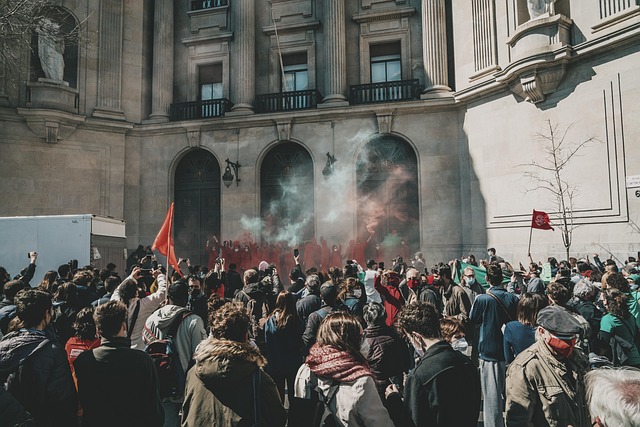
- Global Protests: The track’s universal message against institutional suppression has seen it adopted by student movements, labor strikes, and pro-democracy rallies beyond the Western hemisphere for over four decades.
How does the song fit into *The Wall* film and narrative?
In Alan Parker’s 1982 film adaptation Pink Floyd – The Wall, starring musician Bob Geldof as Pink, Part 2 receives an iconic visual treatment created by animator Gerald Scarfe and director Parker.
The sequence shows school children sitting at uniform wooden desks in a bleak, factory-like building. They wear featureless, flesh-colored masks that erase their individuality as they are conveyed along a conveyor belt, eventually tumbling into a giant industrial meat grinder. This visceral imagery reinforces the song’s primary theme: an educational system operating as a factory line designed to produce obedient, identical citizens while destroying personal creativity.
The narrative context offers crucial background for understanding why Pink chooses to complete his mental wall. The psychological damage inflicted by authority figures during childhood makes total isolation feel like the only safe option, even though that isolation ultimately leads to emotional ruin.
Frequently asked questions
What is the main message of “Another Brick In The Wall”?
The song critiques abusive, authoritarian schooling systems and social pressures that suppress individuality. Songwriter Roger Waters targeted rigid educational environments that enforce obedience through shame and thought control rather than supporting genuine learning.
Which part of “Another Brick In The Wall” was released as a single?
Part 2 was released as a commercial single in late 1979 and became Pink Floyd’s only number-one single in both the UK and US charts. Parts 1 and 3 are shorter, atmospheric tracks that serve specific narrative roles on the full double album.
Who sang the children’s choir in Part 2?
The choir was performed by 23 students from Islington Green School in North London. Sound engineer Nick Griffiths recorded them in their school hall and overdubbed their voices multiple times in the studio to create the sound of a large chorus.
Why was “Another Brick In The Wall” banned in South Africa?
In 1980, black South African students adopted the song as a protest anthem during nationwide boycotts against inferior, segregated schooling under apartheid. The South African government banned the single and the album for inciting civil unrest.
Where can I find more technical detail on the song’s discography?
For complete historical release data, songwriting credits, and chart rankings, consult the Another Brick in the Wall documentation.